Chemoinformatics / Materials Science
Discover new materials/drugs with computational science.
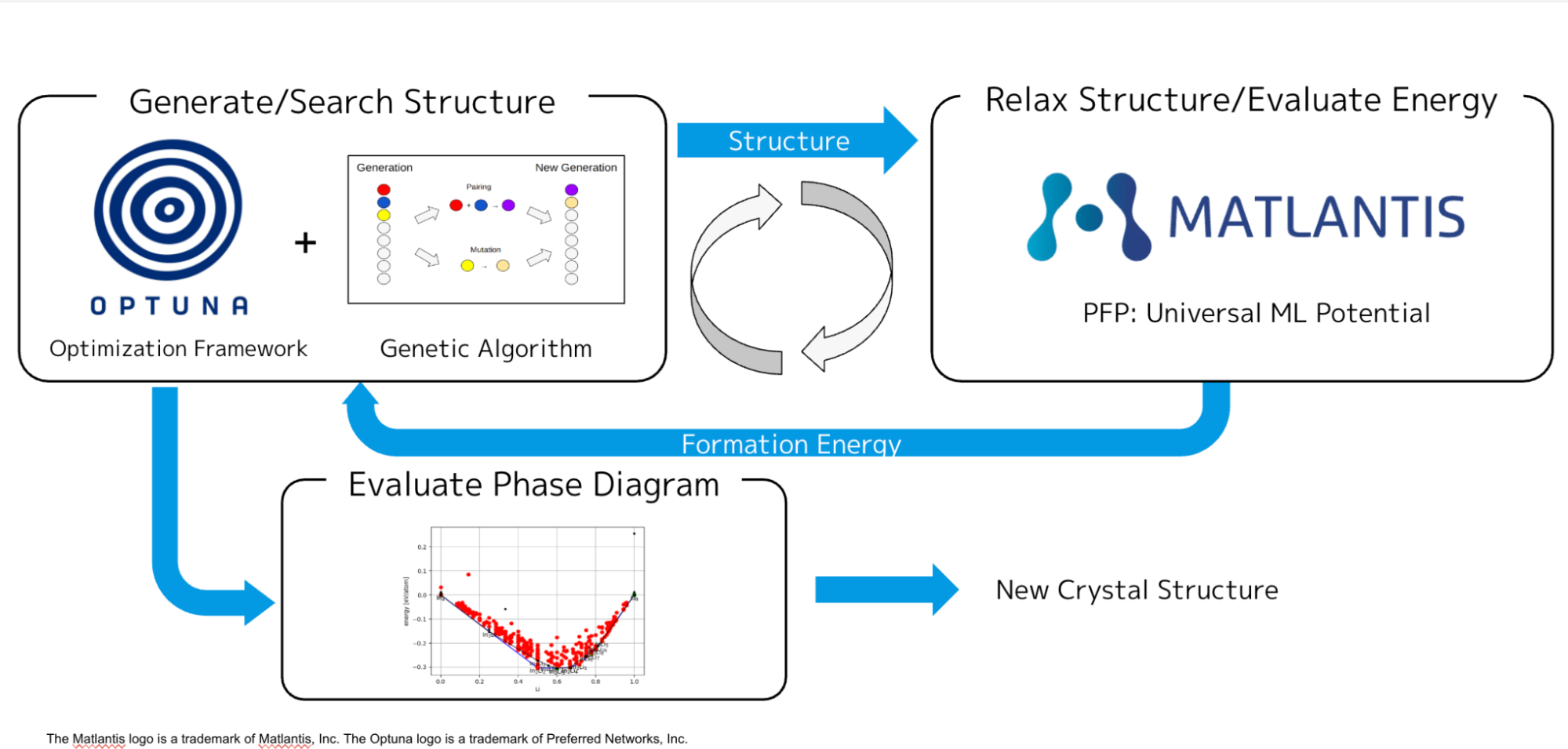
Finding new materials by deep learning and computational simulations*
Material analysis based on computational simulation can be a promising solution to reduce experimental costs and promote new material developments. Current simulation technology is, however, not mature enough to handle tremendous numbers of candidate compounds and materials thoroughly because of its computational cost.
Our goal is to accelerate the process of material developments by high-performance material analysis system based on state-of-the-art deep learning and computational simulation technologies.
Especially, we are engaging R&D activities to achieve such material analysis technology for application to drug and material discovery.
Publications
Efficient Universal Potential Distillation with Pre-trained Students in LightPFP
NeurIPS2025 AI4Mat
By : Wenwen Li, Nontawat Charoenphakdee, Yong-Bin Zhuang, Yuta Tsuboi, Ryuhei Okuno, So Takamoto
P-DRUM: Post-hoc Descriptor-based Residual Uncertainty Modeling for Machine Learning Potentials
NeurIPS2025 ML4PS
By : Shih-Peng Huang, Nontawat Charoenphakdee, Yuta Tsuboi, Yong-Bin Zhuang, Wenwen Li
A practical guide to machine learning interatomic potentials – Status and future
Current Opinion in Solid State and Materials Science
By : Ryan Jacobs, Dane Morgan, Siamak Attarian, Jun Meng, Chen Shen, Zhenghao Wu, Clare Yijia Xie, Julia H. Yang, Nongnuch Artrith, Ben Blaiszik, Gerbrand Ceder, , Kamal Choudhary, Gabor Csanyi, Ekin Dogus Cubuk, Bowen Deng, Ralf Drautz, Xiang Fu, Jonathan Godwin, Vasant Honavar, Olexandr Isayev, Anders Johansson, Boris Kozinsky, Stefano Martiniani, Shyue Ping Ong, Igor Poltavsky, KJ Schmidt, So Takamoto, Aidan P. Thompson, Julia Westermayr, Brandon M. Wood
npj Computational Materials
By : Zetian Mao, Wenwen Li, Jethro Tan